
Wrapping up the People’s Papers project
As a final wrap up to her research placement, PhD student Arielle provides an overview of her research and a summary of paper profiles that she’s put together. The project will also have a dedicated research page on the website soon.
Building on my previous blog posts, the aim of this last update is to provide a fuller summary of some of the papers I looked at in the WCML collection — as a series of paper profiles — along with resources for those interested in learning more or who might want to carry this research forward. As part of that, I’m also excited to announce that we have our first round of digitized papers also now up on the Internet Archive (thanks also to the help of WCML volunteer, Seth!). A more ongoing and in-depth series of updates on the project can also be seen on Instagram @PeoplesPapers.
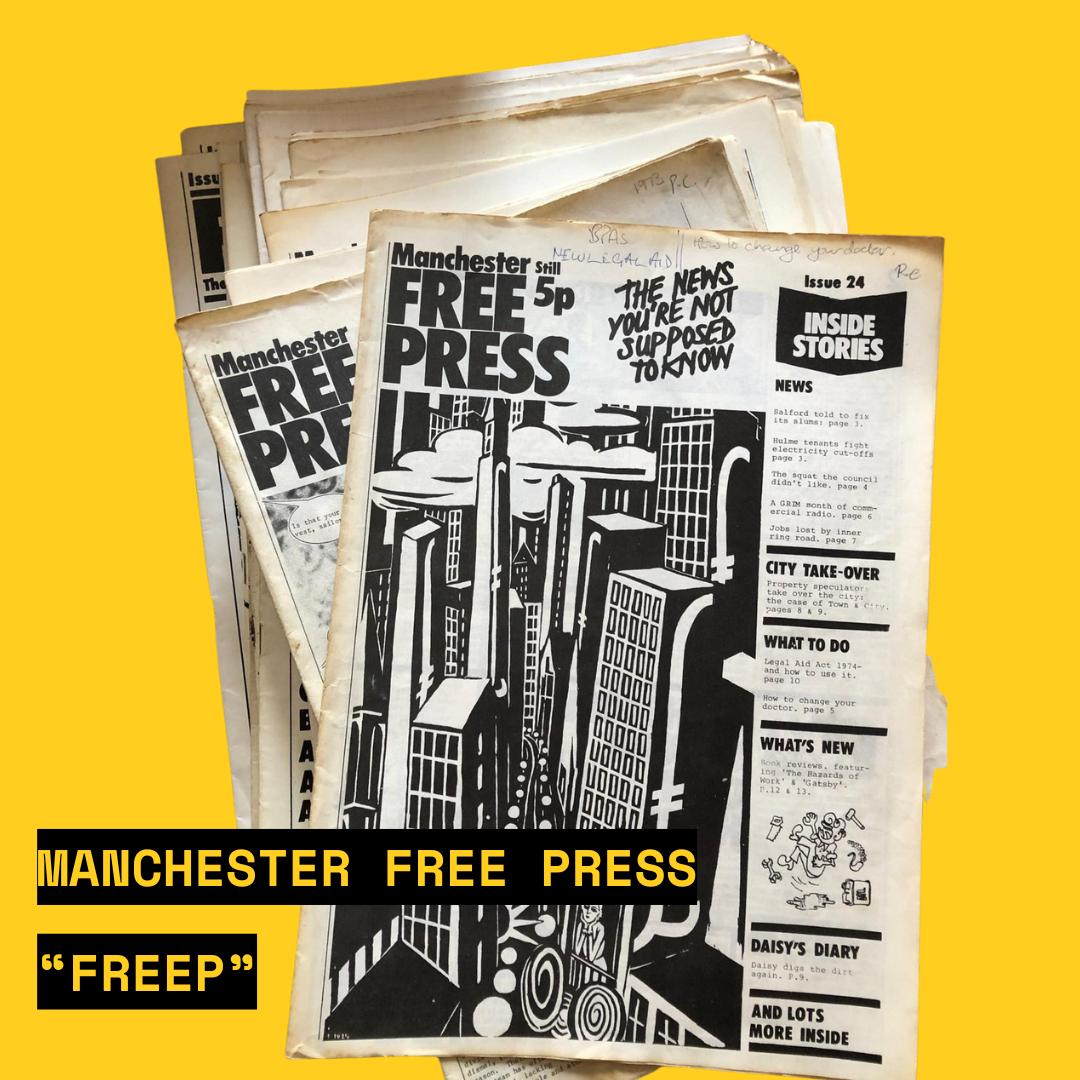
First up in our paper profiles series, which dig a bit deeper into each paper and share more historical background, we have the Manchester Free Press, also known as FREEP!
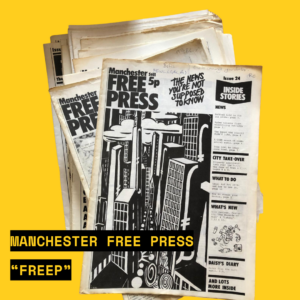
As a Great Manchester-wide paper and initially founded by national newspaper journalists, this represented one of the most established “alternative” (rather than community) newspapers. Along with covering social issues and news stories, it provides an eclectic and humorous mix of content both about the city and more generally — from mapping the best pubs to outlining an action guide for becoming “a print baron.” One of the most valuable sources of historical information today is also their regular (and growing!) section of “Ads & Info,” which provided a fairly comprehensive listing of groups, projects and resources across a wide range of issues. This offers a fascinating view into the 1970s organising scene of the time as well as the broader contested issues facing the city, much of which can be seemingly overlooked or unknown today.
Check out some issues now digitized and accessible online via the Internet Archive!
🔍 Access information: Manchester Free Press: Nos 1-4 (21 Sep-30 Oct 1971); No 7 (Mar 1972); Nos 13, 17 [no dates]; 2x undated issues [ca. 1973]; Nos 20-22, 24, 26-31, 33-48 [no dates]; Special Supplements on the Engineers’ claim (20, 29 Mar 1972) via shelfmark: Periodicals main sequence (Room 31)
(The Central Library has a quite extensive run of the Manchester Free Press that hopefully could also be digitized at some point in the future).
Next up, we have Moss Side News:
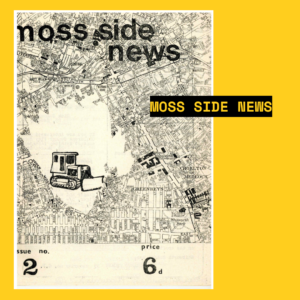
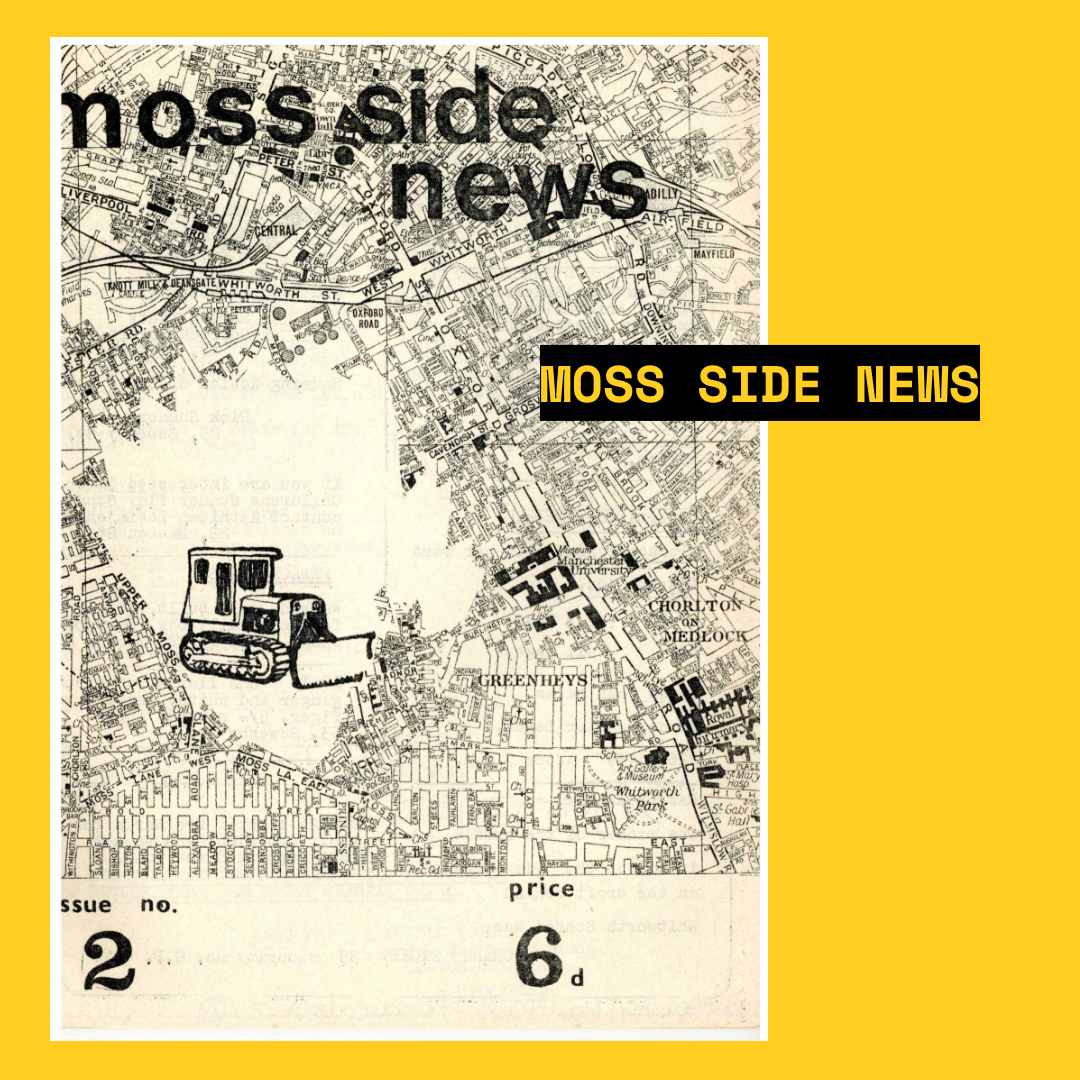
As one of the earliest community newspapers, it formed at the very end of the 1960s in connection to the Moss Side People’s Association and especially in relation to the Housing Action Group confronting the redevelopment of the area.
In their first editorial they write: “In this first issue of Moss Side News are two big articles about the redevelopment and rehousing of the area. We feel that it is extremely important to publish as many facts on this topic as we can discover. However this is not the only purpose of the paper. We will print new and opinion about any topic which we feel would be of interest to people living around here.”
There is a wide range of content and activities covered in the first issue: from petitions and fighting with Town Hall for information about the redevelopment, to organising a parents association, to comics and racing tips and housing action themed astrology (!!) — “it’s all happening in Moss Side !”
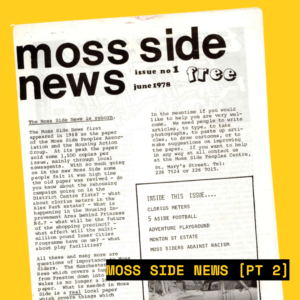
As a follow up, there was also a rebirth of Moss Side News later in the 1970s!
In 1978 the paper was “reborn.” In the first issue of the new series they write: “With so much going on in the new Moss Side some people felt it was high time the old paper was revived.” The same ethos and aims remained: “What is needed in Moss Side is a real local paper which covers things which matter to us.” Browsing through this newer version of the paper provides the opportunity to see both the continuities and differences from this time period and particularly the many projects and organising efforts revolving around the Moss Side Peoples Centre.
We hope to have more of these issues digitized sometime in the near future! But in the meantime you can check out both versions in person at the WCML via the catalogue info below or you can read more about Moss Side News via this AIU Race Centre’s blog post.
🔍 Access information: Moss Side news: Nos 1-8 [ca. 1969] via shelfmark: Manchester – Periodicals A-Z (Room 37); Moss Side news: Nos 1-4 (Jun 1978-[no date]) via shelfmark: Manchester – Periodicals A-Z (Room 37)
Next up, we have Longsight News;

For this one we were lucky enough to connect with a number of people who were involved with the paper at the time and have shared more information as well as filled in some missing issues for the WCML collection. It is also our first community newspaper to now be fully digitized and accessible online!
On the instagram post for the Longsight News paper profile, we have a video with Maggie Walker sharing more about the paper from our People’s Papers event last year, but she’s also provided the shortened written summary below:
Longsight News started in 1974 and ran bi-monthly to the end of 1978 with occasional later issues. It was run by local people who were also involved in other campaigns and community action locally – none were journalists or had any ambitions in that direction. The core of the people involved were active in their local community and had been successful in a major campaign saving some older terraced houses from demolition (“slum clearance”). Other local community action including running playschemes, helping needy families to squat a house, running a local advice centre, campaigning for a community centre and setting up a housing co-op. They were in touch with other housing campaigners locally across Manchester and Salford and networked nationally via the Community Action magazine.
It’s a great exampleof a community newspaper from this period and is a treasure trove of interesting information and news from the neighborhood in the 1970s — highly recommend browsing through the (almost!) full run of issues online or in person!
🔍 Access information: Longsight News: Nos 4-16 (Apr/May 1975-Jul/Aug 1977); No 19 (Spring 1979); No 21 (Nov/Dec 1980) [to be updated!] via Shelfmark: Manchester – Periodicals A-Z (Room 37)
Next up, we have the Manchester Women’s Paper:
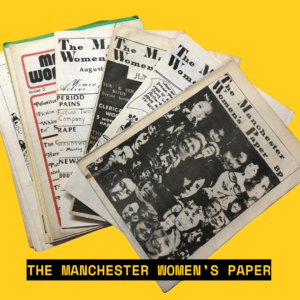
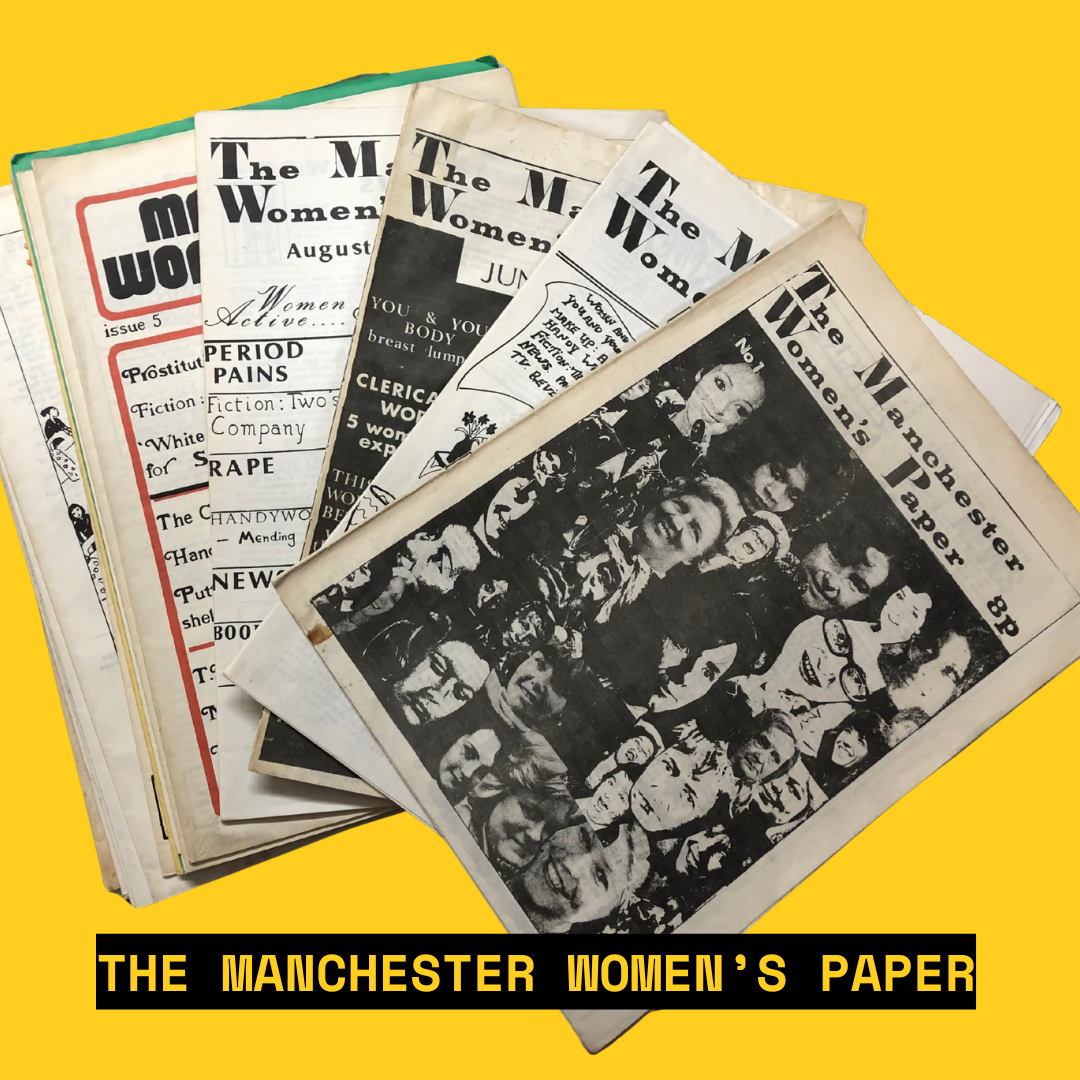
We included this profile as an example of the more expansive range of community newspapers of the time period, which also went beyond specific geographic areas and in this case overlapped with the flourishing feminist movement underway.
While there’s very limited information about the paper currently available on the internet (the autogenerated AI overview doesn’t believe it exists…), we can share what we’ve learned directly from the paper itself. Started as a small collective of women who had no previous publishing experience, they outlined their aims in their first editorial section, writing: “This paper will give any woman in the Manchester area the opportunity to express her own opinions, to tell her own story or to talk about her experiences.” Though originally undated, the paper appears to have begun in 1976 and continued every couple of months up until at least 1983. According to Ways and Means: A Directory of Alternative Information (1978), the Manchester Women’s Paper was a “good feminist paper with wide coverage.”
🔍 Access information: Manchester Women’s Paper: Nos 1-6, 10, 15 [no dates]; Autum 1979; Spring 1980; Sep-Dec 1981; Jan 1982?; Oct/Nov 1983; 1 undated issue via Shelfmark: Women – Periodicals A-Z (Room 37)
In a similar vein, we also included a shout out to the papers Mancunian Gay and the Lesbian Express thanks to Paul Fairweather, who was active specifically with the Mancunian Gay at the time. While the WCML only has one issue of the paper (from 1982), the instagram profile for it includes a video from Paul describing both papers and providing a bit more (unfortunately too rare!) historical background. There are some additional resources online, including some digitized issues on the Manchester Digital Music Archive.
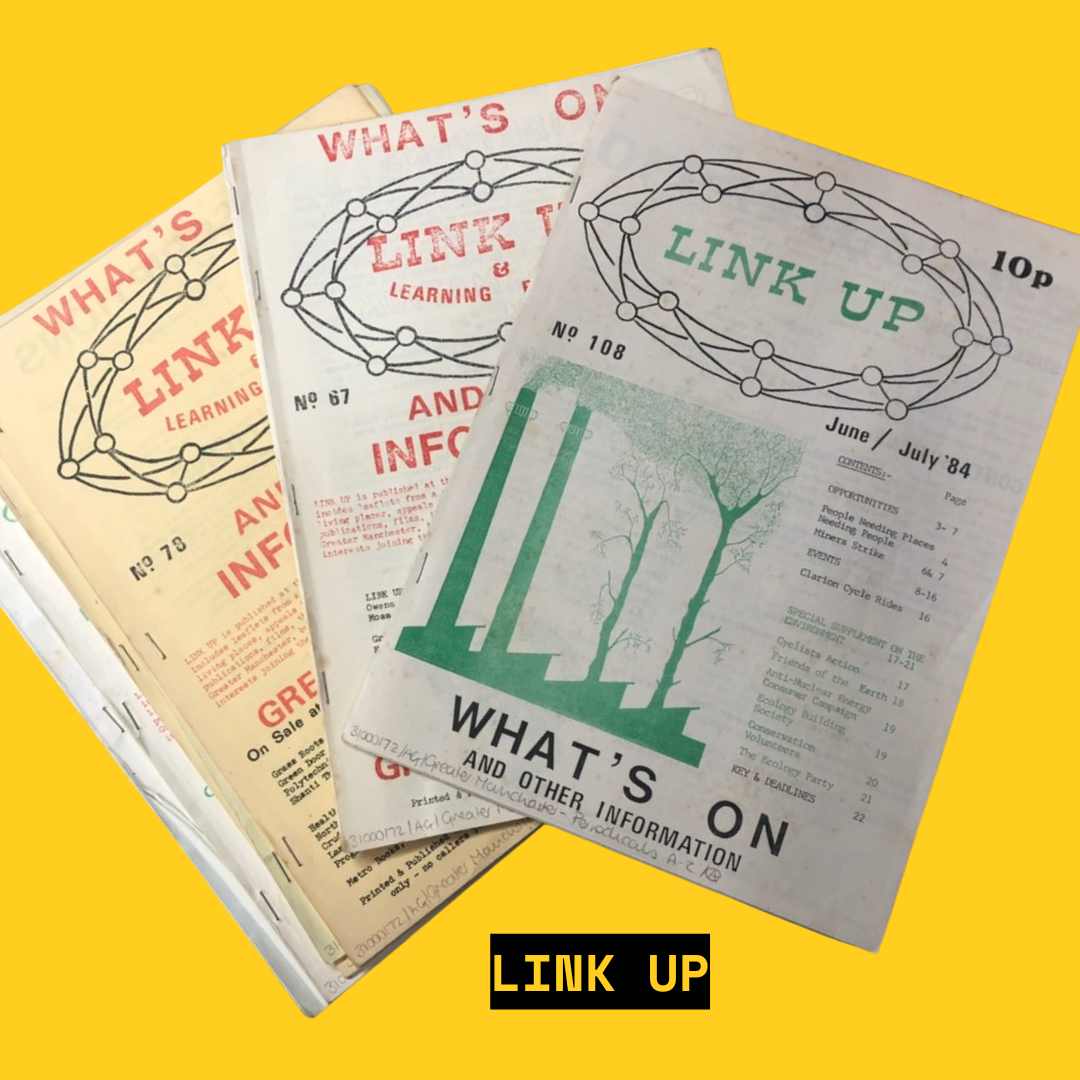
Next up, we also included a profile of Link Up:
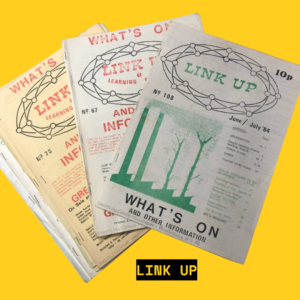
This one is a bit of an outlier compared to our usual selections as it represents more of an “alternative information magazine” rather than newspaper format and the copies we’ve been able to access are actually from the 1980s. However, as one of the speakers at our event last year was involved with the project and it was so intricately tied to other alternative and activist efforts of the time, it seemed like still a good one to spotlight.
With the aim of bringing together and distributing information and opportunities to connect and collaborate across Greater Manchester, Link Up offers a unique window into a cross section of the events and activities of the time. As it self-described: “LINK UP is published at the beginning of each month. It is non-profit making. It includes leaflets from a wide range of groups, plus a listing of job vacancies, communual living places, appeals for help, new or proposed groups, claimants news, events new publications, films theatre shown, and other resources. Information is mainly for Greater Manchester, but jobs and communal living spaces can be anywhere.” A video of Barry Johnson describing the paper from his experience being involved is also available on the Instagram post.
🔍 Access information: Link up: No 67 (Dec 1980); Nos 72, 74 (May, Jul 1981); Nos 78-82 (Nov 1981-Mar 1982); Nos 84-89 (May-Oct 1982); No 91 (Dec 1982); Nos 104, 107, 108 (Jan, Apr/May, Jun/Jul 1984); No 114 (Feb 1985) via Shelfmark: Greater Manchester – Periodicals A-Z (Room 36)
Lastly, we also wanted to feature a paper from Salford, which included the options of the Salford Champion or the Salford Gazette. Yet as the Salford Centennial — Salford 100 — is coming up, we thought we could wait and have it as its own future blog post (as WCML volunteer Seth takes on some additional pieces of this project) — so stay tuned for more!
Paper Profiles
A broader recap:
These initial “paper profiles” aimed to capture some of the breadth and variety of these activist community or city-wide papers, especially related to ones that we were able to connect with original participants on (with the unfortunate exception of Moss Side News, despite our best efforts — though if anyone does still have any connections to that paper, please let us know!).
A key component of the project overall was to figure out what kinds of papers should be included within the scope and criteria of this project, prioritizing a focus on grassroots urban history and activism as well as the form of the newspaper (with some loose boundaries!). It, however, meant that many other types of materials — such as a much broader range of 1970s newsletters, workers periodicals, housing periodicals, music zines, etc — or those more aligned with efforts into the 1980s were for the most part excluded. As mentioned earlier with Link Up and a couple other similar examples, such as MARC Times from the Manchester Area Resource Center, the Salford Gazette, the New Manchester Review (overlapping more with the local music scene) or the City Enquirer (which was more focused on investigative reporting), there’s also been a bit of flexibility in format and affiliation. Recent additional WCML digitizing efforts have also included the publication Drum, the newsletter of the Shanti Third World Centre, thanks to the connection with Colin Archer.
There’s also a significant potential to dive much deeper into the other neighborhood or regional papers that we didn’t fully get into due to lack of capacity or connection to past participants (if anyone was involved with any of these though, please get in touch!). The perhaps most well known example is the Rochdale Alternative Press (or “RAP”), but its history has already been at least a bit more documented. Others included the North Manchester Eye, the Riveria Press (Miles Platting Community News), Metro News (Bury), Tameside Eye, and Leigh People’s Paper (which was revisited in a recent STAT magazine article). Each will be featured as part of the People’s Papers project overview — with a visual example and information about them in the WCML archive — but unfortunately additional historical context or in-depth analysis is (not yet!) included. I personally think it would be a great topic of study, especially for future student research projects. Other examples that were included in the list for the project, but less featured were the more institutionally affiliated papers like the Mancunian Mosaic (from the Manchester Council for Community Relations) and The Mancunian Indian (from the Indian Association of Manchester). These were also only limitedly available in the archive and not easily learned about online, but hopefully future research related to these organizations might be able to provide a more in-depth profile and context for them.
Finally, the last category of papers included in the project but explored in less depth here were the more alternative and countercultural papers from the late 1960s and early 1970s such as the Manchester Grass Eye and the follow up Mole Express as well as Catonsville Roadrunner (which was based both in London and Manchester at various times). On one hand, some of these papers have already received more widespread coverage, such as the Mole Express which is digitized online via the MDMA as part of a significant effort to preserve more of Manchester’s music histories. The Catonsville Roadrunner, on the other hand, is less locally focused and takes on many issues beyond the city and the scope of this project (though still provides a fascinating snapshot into the often little remembered radical Christian scene of activism!).
While this blog post provided a bit more of the background process and development of the project, the final summary of the project as a research page on the WCML website will include a more standardized listing of the papers and where to find them in the archive or online with the hope that this can spur further research and archival exploration.
For anyone who’d like to stay in touch with me or receive updates on the topic of 1970s social movement materials more broadly, please follow the People’s Paper account on Instagram or Bluesky or send along a note at arielle.lawson@postgrad.manchester.ac.uk