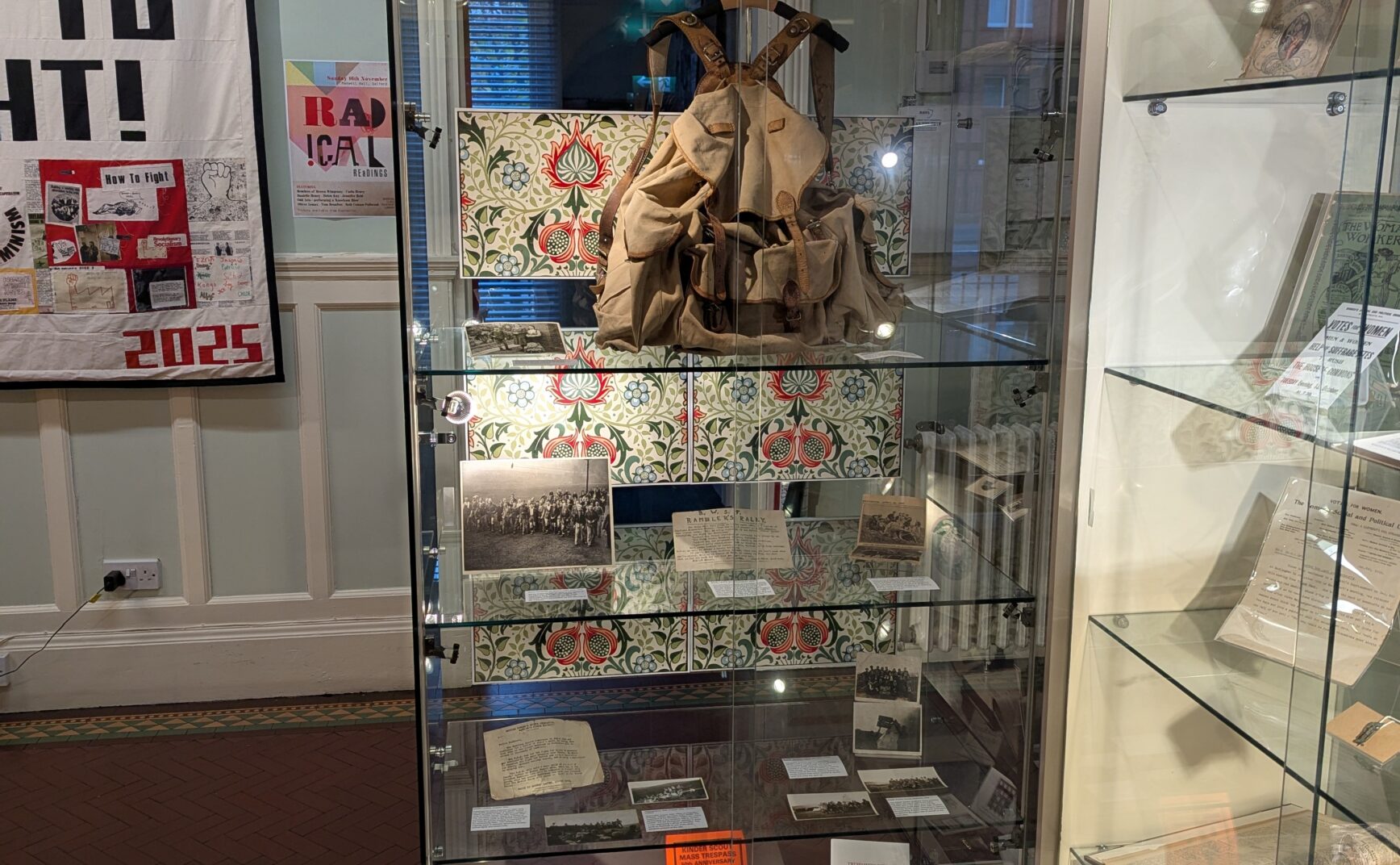
Spotlight on the Collection: Benny Rothman’s Backpack and the British Workers’ Sports Federation
Following its recent donation from Glossop Mountain Rescue, the Library is currently displaying Benny Rothman’s backpack alongside some photographs and ephemera relating to the 1932 Mass Trespass and the British Workers’ Sports Federation. Most famous for his role in organising the mass trespass, Rothman was a socialist activist with a lifelong commitment to campaigning for greater access to the land. It is possible that the backpack was used by Rothman on the day of the mass trespass, which started in the village of Hayfield, a few miles south of Glossop on the edge of the Peak District. Its connection to this historic protest, and to Rothman himself, makes this a significant object in telling the story of land access and the right to roam in the UK.
On the morning of 24th April 1932, a few hundred people – the exact number is still debated – gathered at the recreation ground in the village of Hayfield with the intention of trespassing on Kinder Scout. They were mostly young workers from parts of Manchester and Sheffield, and had only been given a week’s notice of the protest in the form of leaflets and a ‘call to rally’ published in the press. It was organised by the British Workers’ Sports Federation, who had invited any other groups with sympathy for their aims and tactics to join the trespass. Then ‘protected’ by gamekeepers on behalf of landowners, the attractive moorland of Kinder Scout was essentially inaccessible to the public.
The Library houses an extensive collection relating to the trespass including original British Workers’ Sports Federation leaflets, newspaper clippings, photographs, interviews and commemorative material from various anniversaries of the event. In a 1992 interview from the North West Sound Archive, the tape and transcript of which is now housed in the Library, Rothman recalls a confrontation with gamekeepers near Kinder in the spring of 1932, which resulted in the decision to have the mass trespass only a couple of weeks later. Although the story is a familiar one, what struck me when exploring these materials was the swift and rather spontaneous nature of the organisation of the trespass.
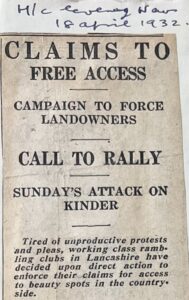
Image caption: ‘Call to rally’ published on 18th April 1932 in the Manchester Evening News
Reference: PP/FROW/4/2/36
This perhaps speaks to the necessity of such bold and decisive direct action under the circumstances. This event happened against a background of increased interest in rambling and a frustrating lack of progress in changes to land access legislation. At that time, the Access to Mountains Bill was making no progress in parliament and confrontations between ramblers and gamekeepers were becoming increasingly aggressive in nature. The more ‘respectable’ national Ramblers’ Federation also expressed frustration, but the actions of the working class organisers of the trespass paved the way for real change.
These young workers had their own organisations, such as the British Workers’ Sports Federation (BWSF), who coordinated the trespass. The BWSF was founded by the Clarion Cycling Club and trade unionists, and organised sports events, camps and rambles for its working class members. They were active from the 1920s into the 1930s and the Library’s archive is home to many significant documents related to their activities and photographs of their members participating in their events. When sorting through these photos, what struck me was the strong sense of fun and comradeship, as well as the significant role women played in the federation’s activities.
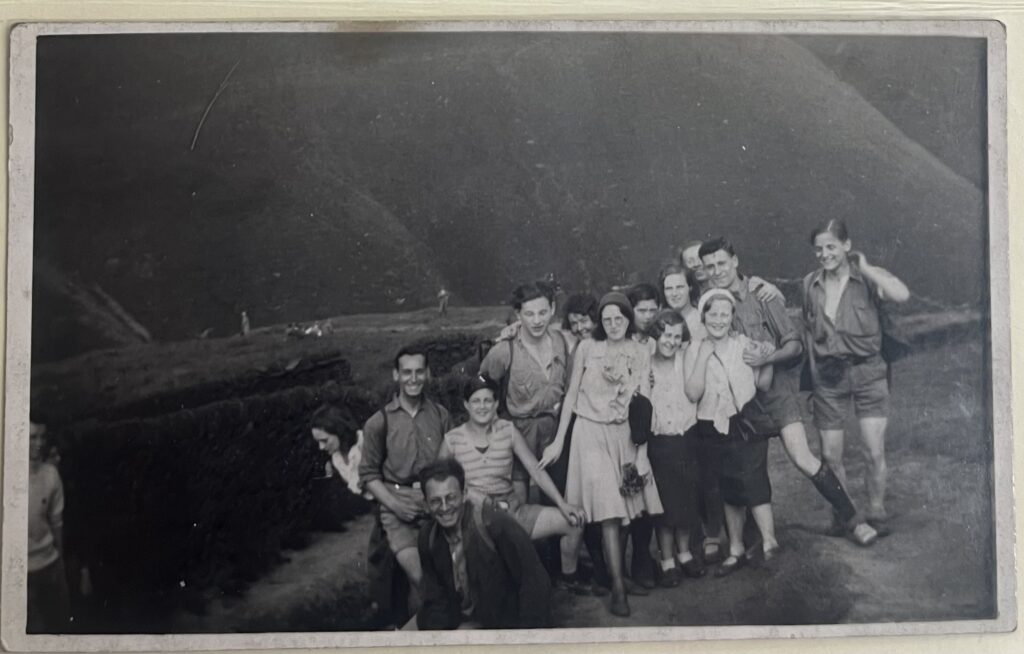
Caption: Members of the BWSF at Jacob’s Ladder, Kinder Scout, on 28th August 1932, at a rally following the release of two of their members imprisoned for their role in the mass trespass.
Reference: PP/ROTHMAN/Box 17
Hiking and rambling can often be perceived as a particularly middle class hobby. In the 1992 interview, Benny Rothman reflects on the class differences between the Ramblers’ Federation members and the thousands of young workers from places like Manchester, Salford and Bolton who went out rambling on weekends to escape the towns and cities, claiming that the former had a tendency to look down on the latter. As well as extending access to the land, the BWSF also focused their campaign on cheaper transport fares and catering facilities, hoping to make rambling even more accessible to the urban working class.
Whilst he is best known for his involvement in the mass trespass, the Library’s Benny Rothman collection also contains material relating to his later work against water privatisation in the 1980s. Over 50 years following the mass trespass, government plans to transfer local water authorities into private hands raised concerns about public access to the countryside. Water authorities owned vast swathes of land which, due to access agreements and permissive footpaths established in decades following the mass trespass, had become popular recreation sites for the public. Rothman was involved in many demonstrations against water privatisation organised on water authority sites, such as Edale, Elan Valley and Rivington. On 7th May 1989, Rothman spoke at a rally in Rivington, where protesters recited this pledge, echoing the sentiment of the 1932 mass trespass
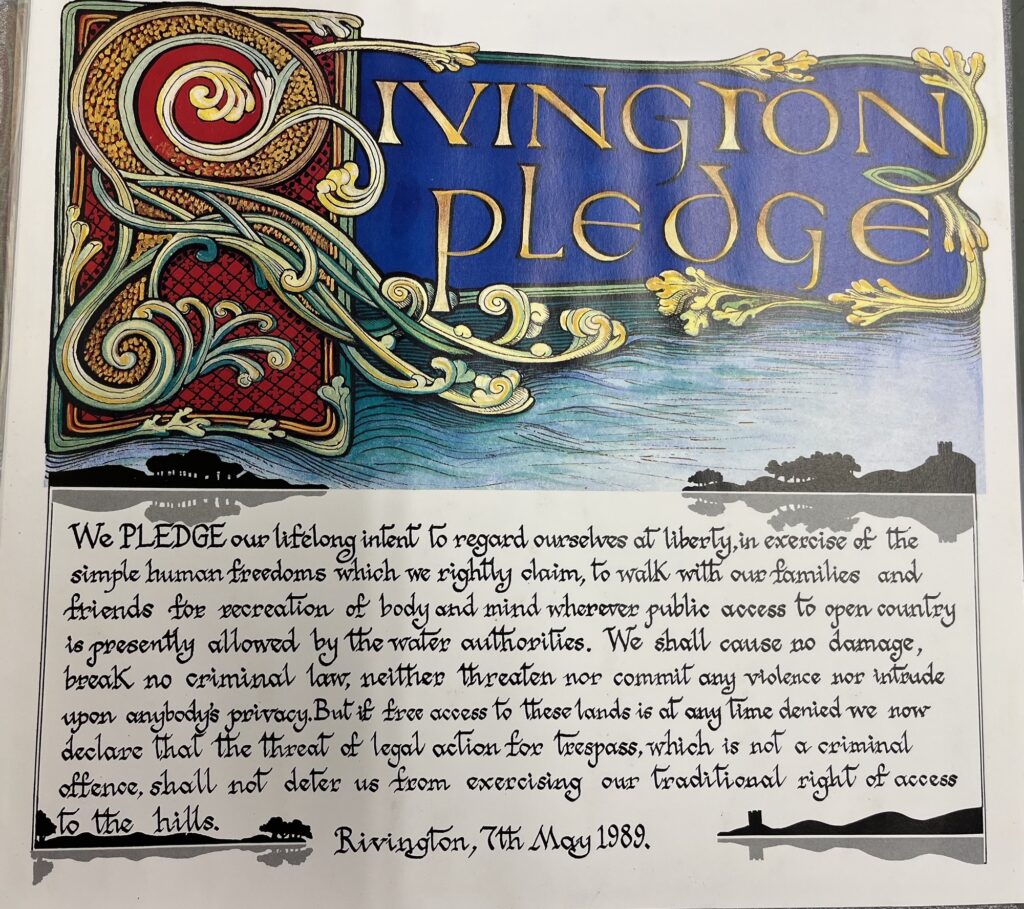
Caption: The Rivington Pledge, 7th May 1989 reads as follows:
We pledge our lifelong intent to regard ourselves at liberty, in exercise of the simple human freedoms which we rightly claim, to walk with our families and friends for recreation of body and mind wherever public access to open country is presently allowed by the water authorities. We shall cause no damage, break no criminal law, neither threaten nor commit any violence nor intrude upon anybody’s privacy. But if free access to these lands is at any time denied we now declare that the threat of legal action for trespass, which is not a criminal offence, shall not deter us from exercising our traditional right of access to the hills.
Reference: FRAMED/435
Benny Rothman’s activism serves as a reminder that public access to the land should not be taken for granted as it was achieved, in part, by significant and persistent acts of protest. The recent pandemic lockdown resulted in an increased public interest in walking, hiking and outdoor pursuits, highlighting the importance of access to green space for recreation. The Right to Roam Campaign, established in 2021, organises peaceful trespasses according to the respectful and responsible access code which currently governs Scotland’s land access legislation. Find out more at https://www.righttoroam.org.uk/ .
You can see the backpack and its accompanying display in the Working Class Movement Library’s foyer and explore our archives by appointment.