
Archive Encounter: The Viraj Mendis Defence Campaign
Viraj Mendis, who took sanctuary in the Ascension Church for over two years in the late 1980s, was a staunch defender of the Tamil cause and the campaign to resist his deportation drew support from across the community, from revolutionary communists to trade unionists and church goers. In the following blog post, Library volunteer Peter explores the campaign through archival items in our collection.
The Viraj Mendis Defence Campaign (VMDC) was established to fight the deportation of Viraj Mendis to Sri Lanka in the late 1980s. Viraj had lived in Britain since 1973 when he came on a student visa as a 17-year-old to study electrical engineering at the University of Manchester. He was politically active and advocated for the rights of his country’s Tamil population including 15 successful anti-deportation campaigns. Viraj also supported the Revolutionary Communist Group. As a result, he feared arrest and persecution if he returned to his native Sri Lanka.
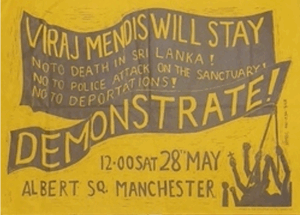
Catalogue Reference: POSTER/SUBJ/VMDC/0001
However, The UK government issued him with a deportation order in 1984, and his appeals were turned down on the grounds that the Sri Lankan government was considered ‘inherently a democracy’ despite Amnesty International’s evidence that political prisoners were detained without trial. The Appeal also ignored his decade of residency which even Home Secretary Douglas Hurd admitted was normally a ‘prima facie reason for granting indefinite leave to remain.’ You can find out more about the impact of Immigration Laws after the Second World War in this blog on our website: How Britain’s Post-War Immigration Laws Failed Refugees of the Commonwealth – Working Class Movement Library

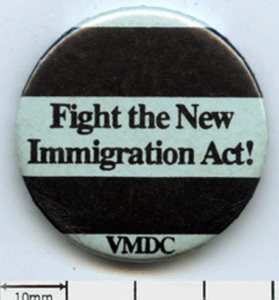
Catalogue Reference: BADGE/SUBJ/RACE/027
As a last resort, Viraj approached Father John Methuen and requested sanctuary at the Church of Ascension in Hulme. Methuen and members of the parochial council agreed to his request and on 20 December 1986 he entered the church. Methuen was clear that the church would only grant sanctuary if the person had a close relationship with the Hulme community, was not involved in violence, was not wanted for a criminal offence, had exhausted all legal proceedings and there was a danger of a ‘monstrous injustice being committed.’ Viraj satisfied all these criteria. The church later organised a conference on Sanctuary that was very well attended and generated a great deal of debate. You can find a detailed report on the conference in our archive.
Viraj sheltered in a small room in the church whilst his appeal reached the House of Lords. Meanwhile, the VMDC led an active and well organised local and national campaign to raise awareness about Viraj and other people in his position. Their bulletins publicised marches and highlighted key developments in the case of the attacks on the church in March 1987, which had been incited by local media reports. They also reported on the political situation in Sri Lanka, and the VMDC was invited to attend the SDLP, Labour, and Green Party conferences in September and October 1988. They were also supported by a range of movements such as the Greenham Common Women’s Peace Camp who protested against nuclear weapons being held there from 1981 to 1987. The strength of their collaboration is reflected in this banner demanding an end to racist laws and nuclear war.
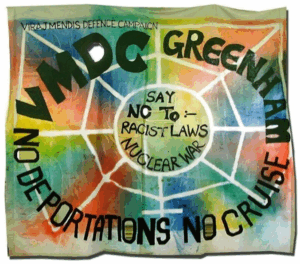
Catalogue Reference: BANNER/093
However, despite a national speaking campaign in December 1988, the final deportation order was signed by the UK government. On 18 January 1989, 13 police vans arrived at the church and 100 police officers smashed into the church and finally removed Viraj Mendis from the tiny room which since 20 December 1986 had been his sanctuary. So ended the ‘longest sanctuary campaign in modern British history.’
The VMDC continued to campaign for Viraj’s safety even after his forcible return to Sri Lanka and Viraj was eventually allowed to leave Sri Lanka for Bremen in Germany, where he established the International Human Rights Association to campaign for the rights of Tamils until his death in 2024. On 1 March 2025, the Church of the Ascension hosted the Viraj Mendis Memorial Meeting to ‘honour the anti-deportation campaign that made national headlines in the 1980s.’
Our collection has a wealth of visual and written resources, from posters and badges to detailed written documents such as the VMDC bulletins, follow the link to our catalogue to learn more. The Church of Ascension also has a section of its website dedicated to Viraj Mendis: The Viraj Mendis Memorial Meeting and Archive Launch — Ascension Church Hulme
BBC Radio Manchester has produced a six part podcast series exploring the Viraj Mendis Defence Campaign and how Viraj found sanctuary at the Ascension Church in Hulme.
BBC Sounds – In Detail… – Available Episodes